FOCUS ON
The China Critic
中國評論週報
This combined June/September 2012 issue of China Heritage Quarterly introduces readers of the early twenty-first century to an important, but now little known, journal of the early twentieth century. Appearing at a time of patriotic concern and social change, intellectual cosmopolitanism and local contestation, the weekly English-language journal The China Critic 中國評論週報 published its first issue in Shanghai in May 1928. Its editors and writers confronted the issues of day with urgency and fluency.
When we introduced readers to T'ien Hsia Monthly 天下月刊 (1935-1941) in the September 2009 issue of China Heritage Quarterly, we remarked that:
T'ien Hsia reflected a positive relationship between the patriotic aspirations of some members of a Western-educated intelligentsia and a generous spirit of cosmopolitanism. Many of the authors featured in the pages of the journal aspired to be an equitable part of the world community; they were close observers of and commentators on recent developments in Euramerican culture while also paying due attention to the major cultural trends of their own world.
The China Critic was similarly a product of a cosmopolitan demeanour, a fluency in English-language expression and ideas and an informed concern for contemporary China, its achievements and its limitations. The era of The Critic was also one of mounting international conflict and patriotic fervour. It is timely to reconsider The Critic and also to make available some of the insightful and controversial writing that appeared in its pages over a fourteen-year period.
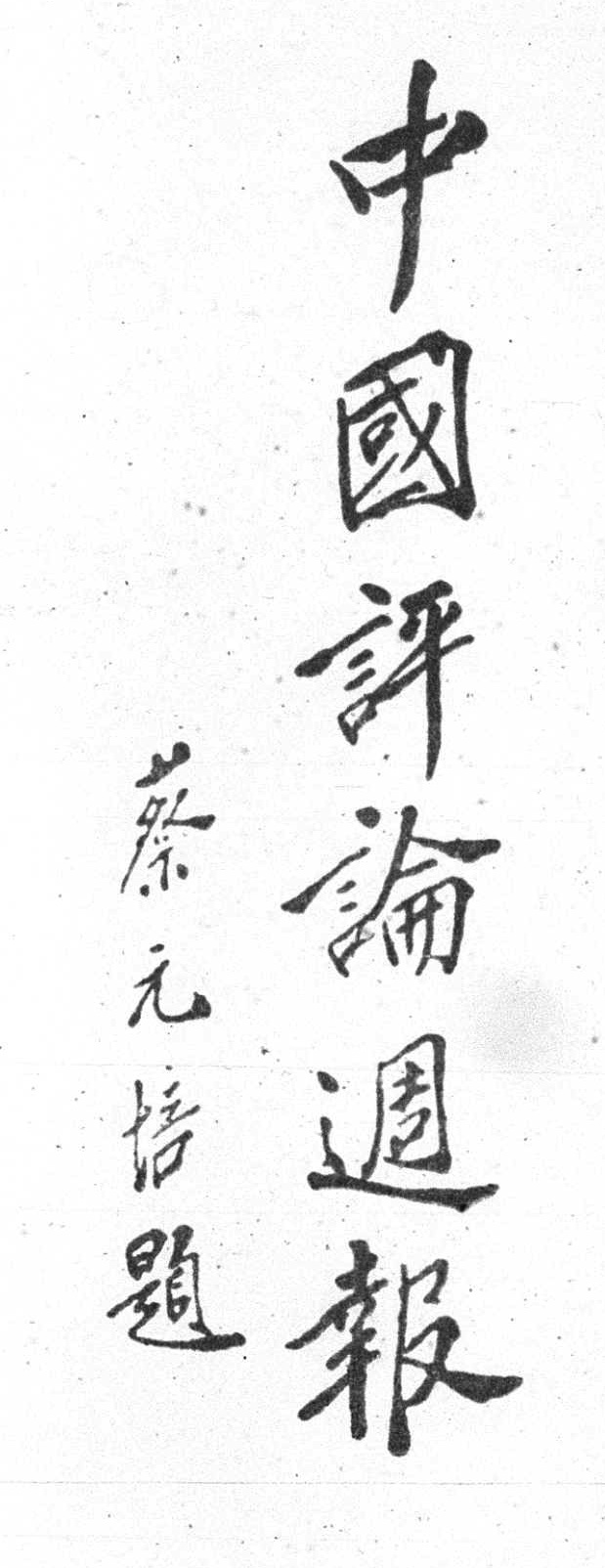
Fig.1 Vertical banner from the cover of The China Critic 中國評論週報, in the hand of Cai Yuanpei 蔡元培 (1868-1940)
In the Features section of this issue we preface our considerations of The China Critic with a major study of earlier English-language and international publications in late-Qing and Republican China by Rudolf Wagner of Heidelberg University.
Then, inspired by the young scholar William Sima's close reading and analysis of The China Critic, we attempt to recreate something of the background, ambient sense and granularity of The Critic itself. To do so, Will (who is a Guest Editor of this issue) has compiled a detailed Chronology. This running account of the weekly provides the political context of the evolving editorial approach of The Critic, as well as offering our readers links to dozens of articles from its pages. In the following section, The Critic at Work, we introduce Eugene Lubot and Lin Yutang, both of whom discuss Chinese liberalism in what was very much an 'illiberal age'. Then, under twenty topic headings, we reproduce feature articles and relevant materials that effectively recreate The Critic itself.
In our 're-publishing' of The China Critic the literary scholar Christopher Rea (a professor at the University of British Columbia who has taken up a one-year fellowship at the Australian Centre on China in the World) has played a substantial role as our other Guest Editor. Apart from his meticulous editorial and copy-editing work on many articles, Chris has written a major essay on the literary maven Qian Zhongshu (錢鍾書, 1910-1998) and what Qian himself called in his irrepressible fashion '批眼', 'The Critic Eye'. (In China Heritage Glossary Chris also contributes a thoughtful essay on the word-universe of lun 論.)
A range of contemporary scholars—Shuang Shen 沈雙, Qian Suoqiao 錢鎖橋, Michael Hill, Frank Dikötter, Leon Rocha and Fan Liya 範麗雅—have kindly offered work on various aspects of the era in which The China Critic was published, or on issues that featured in its pages. In New Scholarship, Shuge Wei 魏舒歌 also introduces her recently completed doctoral thesis on Republican era English-language propaganda. This body of recent scholarship provides new insights into the extraordinary period known as 'the Nanjing Decade'. It is fortuitous since the December 2012 issue of China Heritage Quarterly takes as its focus the city and world of Nanjing/Nanking (our issue devoted to 'Fakes, Phonies, Forgeries and Follies' will appear in 2013).
In T'ien Hsia we reproduce an essay by Lin Yutang (林語堂, 1895-1976), the irrepressible 'Little Critic', on censorship. It is a piece that, like so much of the material presented in these virtual pages from The China Critic era, reads as though it is addressing the realities of today's China, and not merely those of eighty years hence. Jeffrey Wasserstrom remarks on the American literary ingénue, Emily Hahn, who has previously featured in our work on Shanghai and T'ien Hsia, and we conclude Pierre Ryckmans' 1996 Boyer Lectures with his meditation on 'going abroad and staying home'. We finish this section with a recent study by the literary scholar Wu Meng 鄔蒙, who discusses the resonances of travel, displacement and identity in the fiction of Mu Xin 木心 and Pai Hsien-yung 白先勇.
In Articles Tina Kanagaratnam introduces the M Literary Festivals of Shanghai and Beijing which, in recent years, have become a feature of the neo-cosmopolitan cultural life of those two cities, and we reprint a chapter from Randall Gould's 1946 book, China In the Sun. New Scholarship continues our discussion of the Qing reformer/Republican thinker Kang Youwei 康有為. Also in this section David Brophy, an historian with the Australian Centre on China in the World, offers an update on Frontier (Inner Asian) Studies. Our colleague Duncan Campbell and his team of young scholars conclude this issue with a selection of letters from the great late-Ming writer of belle-lettres, Yuan Hongdao (袁宏道, 1568-1610). It seems a fitting end for an issue in which the 'Little Critic' Lin Yutang features so prominently. In the 1930s, Lin introduced a generation of Republican readers to Yuan, his talented brothers and many other important but neglected writers of the Ming era.
My thanks go to Daniel Sanderson, our Associate Editor, for his inordinate forbearance and tolerance during what has been an extended editorial process.
The Dragon Year of 2012-2013 marks a major moment of national political transition in China. Like so many dragon years in the past, this year has been witness both to high drama and to political farce. It has also been a period when, as in The China Critic years, Sino-Japanese tensions have featured prominently. As work on this combined issue of China Heritage Quarterly was drawing to an end, the Australian Centre on China in the World, under whose aegis this e-journal appears, launched The China Story Project, along with a yearbook (see: www.thechinastory.org). The Project attempts to provide varying accounts of The China Story. It is a story that has been told, debated, retold and contended since the end of the Qing dynasty over a century ago. Reconsidering The China Critic some eighty-five years since its debut is also timely as China confronts many of the issues that relate to that country's 'unfinished twentieth century'.
—Geremie R. Barmé, Editor
|
